Rodent Droppings Identification
Found droppings in your South Lake Tahoe home? Learn to tell deer mouse, house mouse, and Norway rat droppings apart — and what to do about each. When in doubt, call us for a free inspection.
LICENSED & CERTIFIED
RODENT-ONLY SPECIALISTS
SAME-DAY VISITS
PHOTO REPORTS
Quick Identification Chart
| Feature | Deer Mouse | House Mouse | Norway Rat |
|---|---|---|---|
| Size | 1/8 to 1/4 inch | 1/8 to 1/4 inch | 1/2 to 3/4 inch |
| Shape | Thin, pointed ends | Thin, pointed both ends | Capsule-shaped, blunt ends |
| Color (fresh) | Dark brown to black, shiny | Dark brown to black, shiny | Dark brown, shiny |
| Color (old) | Gray, dry, crumbly | Gray, dry, crumbly | Gray, dry, hard |
| Droppings per day | 50–75 per mouse | 50–75 per mouse | 40–50 per rat |
| Hantavirus risk | Yes — primary carrier | Low | Low |
| Typical location | Attic, cabin corners, garage, wall voids | Kitchen drawers, pantry, behind appliances | Crawlspace, garage floor, near lake shoreline |
A note on roof rats: Roof rats are rare at 6,225 feet elevation. If someone told you the scratching in your attic is roof rats, it’s almost certainly deer mice or house mice. Roof rats are warm-climate climbers — they don’t thrive at this altitude. Don’t pay for a treatment plan built around the wrong species.
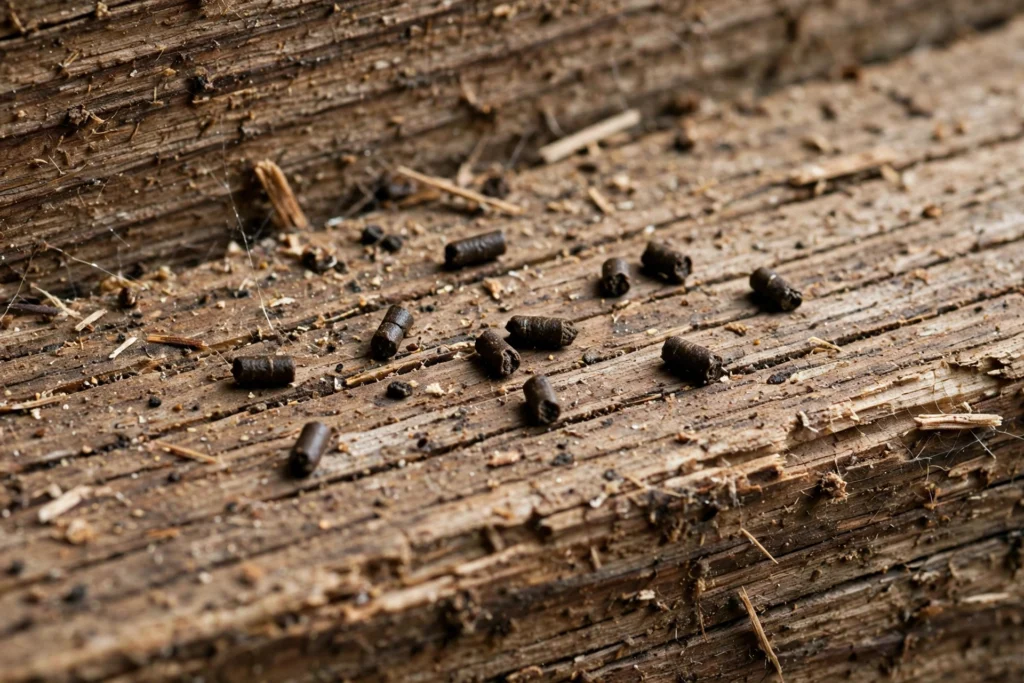
- Size is the fastest clue. Mouse droppings (deer or house) are 1/8 to 1/4 inch — about the size of a grain of rice. Norway rat droppings are 1/2 to 3/4 inch — noticeably bigger, like a large dark bean.
- Fresh means active. Fresh droppings are dark, soft, and shiny. Old droppings are gray, dry, and crumbly. Fresh droppings mean rodents are in your house right now.
- Deer mouse droppings demand respect. Deer mice are the primary hantavirus carriers in California. Never sweep or vacuum droppings — use the wet cleanup method below.
Found something and not sure? Take a photo with a coin for scale. Rodent Killer will identify the species during your free inspection and tell you exactly what to do.
I found droppings but can’t tell if they’re fresh. Does it matter?
Yes. Fresh droppings (dark, shiny, soft) mean rodents are currently active in your house. Old droppings (gray, dry, crumbly) mean past activity. Don’t touch them either way — take a photo and call us.
Can I get sick from old, dried-out droppings?
Yes. Hantavirus can remain viable in dried droppings for days at room temperature, and longer in cool, dark environments. Always use the wet cleanup method.
Should I be worried about hantavirus in South Lake Tahoe?
Take it seriously. Deer mice are native here and are the primary hantavirus carriers in the Sierra Nevada. Treat every deer mouse dropping as if it could be infectious.
Deer Mouse Droppings — The Ones to Take Seriously
Deer mouse droppings are small — about the size of a grain of rice, an eighth to a quarter inch, thin with pointed ends. Dark brown to black when fresh; gray and crumbly when old. They look almost identical to house mouse droppings — the species ID comes from context and location more than the dropping itself.
Where you’ll find them: Attic rafters, cabin corners, garages, wall voids, storage sheds, around woodpiles. Deer mice drop feces constantly as they move — scattered along travel paths, clustered near nests.
The hantavirus factor: Deer mice are the primary hantavirus carriers in California. Inhaling dust from disturbed droppings in an enclosed space is how people get sick — which is why the CDC has a specific cleanup protocol for these mice.
House Mouse Droppings — Common Indoors
House mouse droppings look nearly identical to deer mouse droppings — same size, same shape. The difference is location and behavior.
Where you’ll find them: Kitchens, drawers, pantry shelves, behind the stove and refrigerator. House mice live close to people and food. Droppings in the kitchen and pantry mean house mice; droppings in the attic, garage, or a vacant cabin mean deer mice.
Fresh vs. old: Fresh droppings are dark, soft, and shiny. Old droppings are gray and crumbly. Both together means the infestation has been going on a while.
Norway Rat Droppings — Uncommon Here, Possible Near the Lake
Norway rat droppings are the biggest of the three — half to three-quarters of an inch, capsule-shaped with blunt ends, like a large dark bean. Noticeably bigger than anything a mouse leaves.
Where you’ll find them: Crawlspaces, along foundation walls, garages at floor level, near burrow entries. Norway rats are ground dwellers — uncommon in South Lake Tahoe, but possible near the lake shoreline and the Tahoe Keys.
What it tells you: Large droppings with blunt ends at ground level — especially with burrow holes near the foundation — points to Norway rats.
Other Droppings You Might Find in the Sierra
Not everything in your cabin is from a rodent. Here’s how to rule out the others:
Squirrel Droppings
- Size: About 3/8 inch — between mouse and rat
- Shape: Barrel-shaped, rounded ends, lighter brown than rodent droppings
- Where: Attic spaces, near roofline entry points
- How to tell: Lighter in color than mouse droppings. Sierra pine squirrels and chipmunks are common in SLT attics near tree cover.
Bat Guano
- Size: Similar to mouse droppings, 1/4 inch
- Where: Below roosting sites — eaves, attic peaks, chimney areas
- How to tell: Crumbles into shiny, powdery dust with visible insect wing fragments. Mouse droppings crumble into dull, uniform dust. Shiny specks = bat.
What the Location Tells You
| Location | Most Likely Species |
|---|---|
| Attic — along rafters or in insulation | Deer mouse |
| Vacant cabin — corners, closets | Deer mouse |
| Garage — along walls | Deer mouse or house mouse |
| Kitchen drawers, counters, pantry | House mouse |
| Behind stove or refrigerator | House mouse |
| Crawlspace — along walls | Norway rat (possible) or deer mouse |
| Near lake shoreline burrows | Norway rat (possible) |
| Attic near soffit or gable vent | Squirrel (check color and size) |
| Eaves or chimney area | Bat guano (check for shiny specks) |
Why DIY Identification Goes Wrong
Assuming it’s “just mice.” In the Sierra, “just mice” often means deer mice — and that means hantavirus.
Cleaning before identifying. If you vacuum up the droppings before anyone sees them, you’ve destroyed the evidence and potentially exposed yourself. Take a photo first — then call us.
How to Safely Clean Up Rodent Droppings — The Hantavirus-Safe Way
Because deer mice are the dominant species up here, take this seriously. This is the CDC’s recommended protocol:
Step 1 — Ventilate
Open windows and doors for 30 minutes before starting.
Step 2 — Gear Up
Rubber or latex gloves. In an attic or crawlspace with heavy contamination, wear a real respirator, not a paper dust mask.
Step 3 — Do NOT Sweep or Vacuum
This is the single most important rule. Sweeping or vacuuming launches virus particles into the air. Use a wet method instead.
Step 4 — Soak First
Spray the droppings with disinfectant (1 part bleach to 10 parts water) and let them soak for 5 minutes.
Step 5 — Wipe Up, Disinfect, and Wash
Wipe up with paper towels, double-bag, and dispose in the outdoor trash. Disinfect all surfaces where droppings were found, then wash your hands thoroughly.
For heavy contamination — especially deer mouse accumulation in an attic or crawlspace — call us. Professional cleanup with HEPA-filtered equipment is the safe call.
What Does It Cost to Get Rid of Them?
| Service | Price |
|---|---|
| Inspection | Free |
| One-Time Rodent Removal | starting at $199 |
| Removal + Full Exclusion | starting at $349 |
| Monthly Protection Plan | $49–$59/month |
| Attic Cleanup & Restoration | custom quote |
Once you know what you’re dealing with, here’s the pricing: free inspection, one-time rodent removal starting at $199, removal plus full exclusion starting at $349, monthly protection at $49–$59/month. Exact price depends on your home and the extent of the problem — we give you the real number after the free inspection.
Our Services
Mice Removal
Deer mice and house mice — trapped, removed, and sealed out for good.
Rat Control
An honest look at rats at 6,225 feet — what we actually find up here.
Exclusion & Sealing
Seal them out for good — galvanized steel mesh, metal flashing, and hardware cloth.
Attic Cleanup
Insulation restoration after rodents — sanitize, deodorize, and restore.
Crawl Space
Crawlspace rodent control — find and seal the gaps they slip through.
Areas We Serve
Our primary service area is South Lake Tahoe, CA 96150:
Tahoe Keys
Waterfront homes and canals — Norway rats possible near the water.
Tahoe Island
Older homes with aging foundations and utility penetrations.
Gardner Mountain
Rock foundations and crawl spaces, professionally sealed.
Tahoe Valley
Older neighborhoods near the Y — gaps mice slip right through.
Stateline Residential
Year-round homes and vacation rentals.
Highland Woods
Forest lots — woodpiles invite mice into crawl spaces and garages.
Sierra Tract
Deer mice move in from the tree line every fall.
Al Tahoe
Older cabins in dense tree cover — quiet nesting spots.
Bijou Pines
Pine lots and classic cabins — quarter-inch gaps are all it takes.
Heavenly Valley
Slopeside homes — heavy fall activity before the first snow.
Bijou Park
Older homes with real gaps and plenty of entry points.
Lakeside Park
Near the lake.
Winnemucca
Residential rodent removal.
Bonanza
Residential rodent removal.
Pioneer Village
Residential rodent removal.
We also help homeowners in nearby basin communities, including Zephyr Cove NV, Glenbrook NV, Incline Village, and Truckee.
Droppings FAQs — South Lake Tahoe
The Rodent Killer Guarantee
If rodent activity returns between visits, we come back and re-treat — free. Exclusion work done on a prevention plan carries a 12-month warranty.
We find them, trap them, and seal them out — and we guarantee it.
Not Sure What You’re Looking At? Call Us.
Send us a description or bring it up during your free inspection. We’ll tell you the species, the risk, and what to do about it.
Licensed · Insured · Locally Owned · Rodent-Free Guarantee